

All That's Good to Know About Taking a Eurostar
Discover what's useful to know about the trains, checking-in, boarding, the journeys and the stations, when travelling by Eurostar!
Table of Contents
Share
.jpg?width=768&resize=contain&quality=80)
Taking a Eurostar train can be exciting, thanks to whizzing through multiple countries at speeds of up to 300 km/h!
However, for some it can be something of a barrier to travel - with perceptions that it's expensive, confusing and generally a rather strange method of getting from A to B.
However, a journey by Eurostar can be flipped from daunting to straightforward with some advance planning.
Tickets will be cheaper if booked in advance, rail pass reservations will be available on a wider choice of departures and it's a good idea to have a sense of the timings, that will make the journey easier.
Hence these 36 facts and tips from someone who has made 16 journeys on Eurostar's trains - Use the Content Menu to jump to what you want to know!
The Routes and the Trains:
(1) Eurostar isn't a train, it's now a branded network of services along high speed rail routes in north-west Europe.
(2) The core Eurostar routes are:
- London <> Paris
- London <> Lille - Brussels* - Rotterdam - Amsterdam
- Paris <> Brussels - Antwerp - Rotterdam - Schiphol Airport - Amsterdam
- Paris <> Brussels - Liege - Aachen - Cologne** - Dusseldorf - Duisburg - Essen - Dortmund
*= most trains operate London <> Brussels
**= most trains operate Paris <> Cologne
(3) Unusually for a rail service in western Europe, the trains from and to London cross a time zone.
The typical journey times are around*:
- London <> Paris = 2hr 30mins
- London <> Brussels = 2hrs
- London <> Amsterdam = 4hr 10mins
- London <> Lille = 1hr 25mins
- London <>Rotterdam = 3hr 25mins
*= the actual times have been rounded up or down for clarity.
However, because of the time difference between Britain and mainland Europe, it can seem as though the journey will be an hour longer when travelling from London.
Conversely the journey time can look an hour shorter when travelling to London.
Though the time zone difference can make a difference when planning itineraries for using Eurail and Interrail passes.
On journeys from the UK there will be an hour less in which to travel to locations beyond Brussels, Lille and Paris.
But when travelling to London, the hour gained makes it a little more comfortable to travel on to the likes of Edinburgh, Liverpool or Manchester.
(4) When looking up any Eurostar journey there will be a choice between travelling by Eurostar Standard, Eurostar Plus and Eurostar Premier.
These categories don't solely impact on the travel experience, as they also matter in terms of how the tickets can be used and managed - see below.
Specific seating saloons are used to house the Standard Class ticket bookers, which are arranged 2 + 2 across the aisle with fewer table seats.
Though most of the seats throughout the train are arranged airline style, with pull down tables.
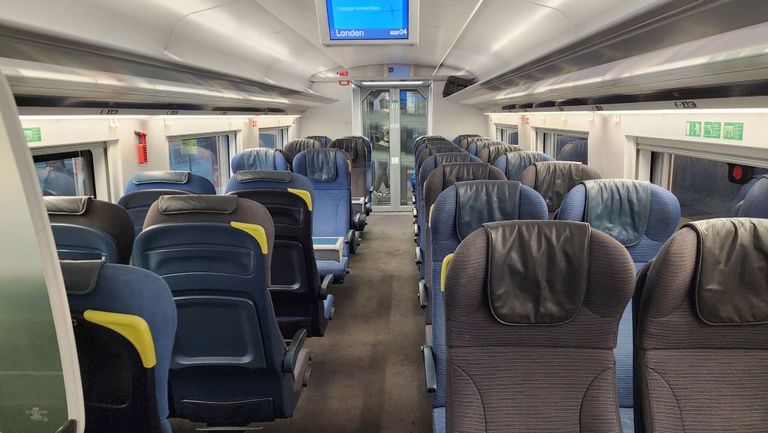
(5) On board the trains the same types of seating area; wider seats, 2 +1 across the aisle, larger tables, power / USB sockets per seat, are used by Plus and Premier ticket holders.
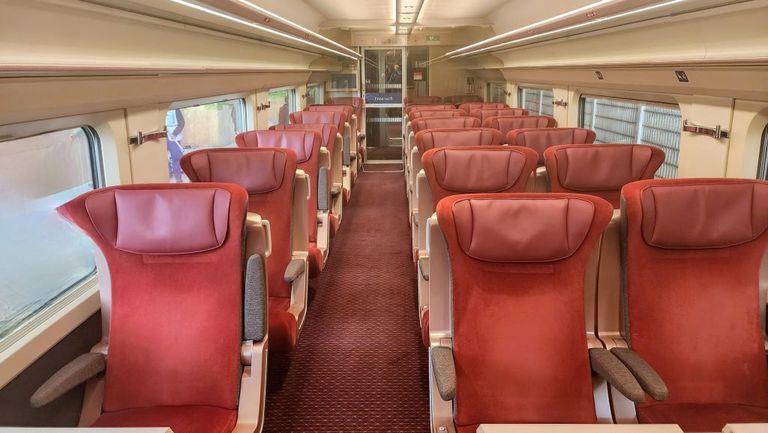
(6) Eurostar trains do not have Family Zones or compartments.
(7) Eurostar now provides the only direct service between Bruxelles-Midi and Amsterdam Centraal stations.
The EuroCity Direct trains which also travel between Brussels and Amsterdam call at Amsteram-Zuid station.
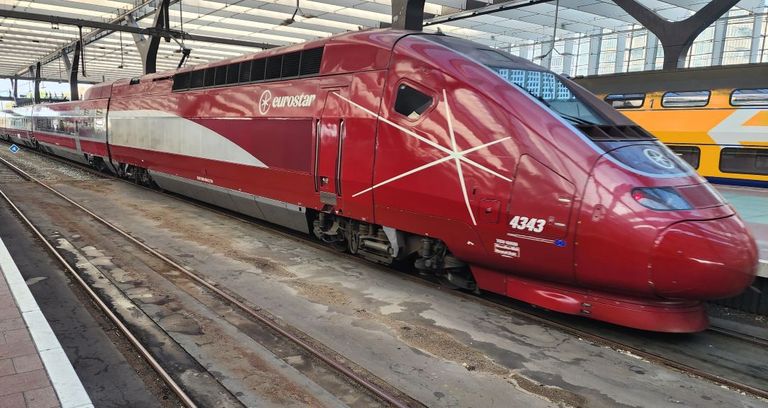
(8) Until 2023 the services on the Paris <> Germany / Netherlands routes were branded as 'Thalys' and they still have differences that matter, compared to the Eurostar services from and to London:
- Book a Plus class ticket and you will be served a light meal on the London trains, but not on the other services.
- The terms and prices around additional and larger items of luggage including bicycles are different on the London trains.
- The reservation fees which have to be paid by those travelling with Eurail and Interrail passes, are different on the London trains.
.jpg?width=768&resize=contain&quality=80)
(9) The trains on the routes from and to London have a blue livery and the trains on the routes between Paris and Belgium, Germany and The Netherlands are red - Hence you may come across uses of 'Eurostar Blue' and 'Eurostar Red' to distinguish between the services.
Though not by Eurostar, it evidently believes that a single branding for all of its routes, services and departures is more important.
The Stations and Boarding:
(10) Another point of distinction between taking a Eurostar 'Blue' train and the 'Red' trains which don't serve London, is that not as much time and thought has to be given to the 'Red' trains pre-boarding.
When taking the non-London routes, Eurostar recommends being at the station only 20 mins before departure - Except for at Paris Gare Du Nord where it is 30 mins, because queues can build at the ticket gates for the trains heading to Belgium and beyond.
(11) At the stations used by both the 'blue' and 'red' trains, if you will be taking a train to London, you will transit through a specific terminal / departure area - So will need to follow the signs pointing the way to the London / UK trains.
The trains which don't travel to London tend to depart from specific sets of platforms / tracks within the stations, but accessing them and boarding is no different to taking a regular train.
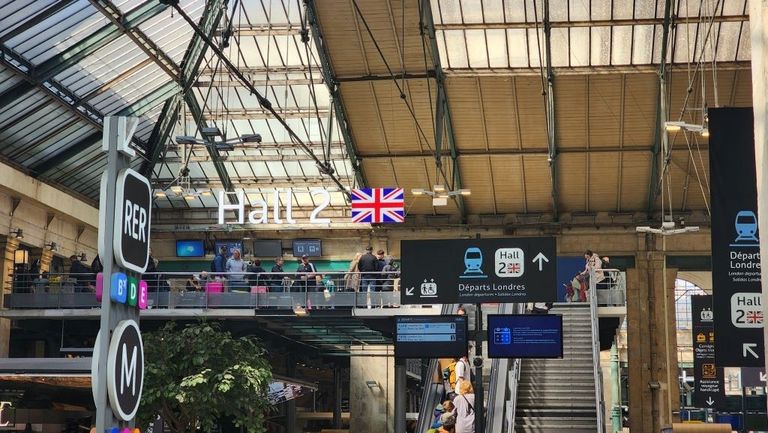
(12) At the stations at which the Eurostar trains from and to London can be boarded, you may expect the trains and the access to them to be dominant - but at all of these stations the overwhelming majority of the departures are by regular trains.
Hence the check-in areas for the London trains are somewhat hidden and have to be found by following the signs.
- At Amsterdam Centraal a relatively new UK terminal has been opened, which is to the right hand side of the main building at the front of the station.
- At Bruxelles-Midi, the 'Channel Terminal' entrance is at the western end of the main Hall de gare / Stationshal.
- At Lille Europe the Hall 4 which gives the access to the Eurostar trains to London is at the far western end of the station.
- At London St Pancras International the Eurostar check-in desks are somewhat hidden in an area to one side its main 'Arcade'.
- At Paris Gare Du Nord the Hall 2 for 'Départs Londres' is at un upper level above the western side of the main concourse.
- At Rotterdam Centraal the Eurostar terminal is on platform 2, which can be accessed after passing through the line of ticket gates.
(13) Eurostar has these recommendations for when travellers should be at the station, ahead of departure, when taking the trains from and to London:
- at St Pancras International: Standard and Plus ticket holders = 1hr 15mins; Premier ticket holders = 45 mins
- at Bruxelles-Midi / Brussel Zuid: Standard and Plus ticket holders = 45 mins to 1hr; Premier ticket holders = 30 to 45 mins
- at Amsterdam Centraal: Standard and Plus ticket holders = 1hr 15mins to 1hr 30mins; Premier ticket holders = 30 mins
- at Lille Europe: Standard and Plus ticket holders = 1hr; Premier ticket holders = 30 mins
- at Paris Gare du Nord: Standard and Plus ticket holders = 1hr 15mins to 1hr 30mins; Premier ticket holders = 45 mins to 1hr
- at Rotterdam Centraal: Standard and Plus ticket holders = 45 mins to 1hr; Premier ticket holders = 30 mins
In my experience these times are not excessive, because...
Checking In and Passport Control on the London trains
(14) Checking in for the Eurostar trains from and to London is different to checking-in for a flight
- All travellers have to pass through a manual check-in / ticket check procedure, there is no checking in advance online, or any automated check-in / boarding pass collection machines at the stations.
- There is no bag drop, because travellers keep all of their luggage with them and it has to be screened - Similar to how hand luggage is screened at airport terminals. Hence more bags have to be screened pre-boarding compared to taking a flight.
There are no fast-track lanes for travellers who don't have heavy luggage.
(15) The other reason for these times at stations not being excessive is that the newer Eurostar trains, used for most departures on the London routes, can transport more than 900 people.
Check-in can be open for up to three departures, so more than 2000 people (4 x Airbus A380s) per hour need to be processed at the busiest times.
(16) To facilitate trains leaving on time, dedicated gates are usually allocated per specific departure; These are closed 30 mins ahead of departure for Plus and Standard ticket holders and 15 mins ahead for Premier ticket holders.
Get to the gate after this time and you may be denied boarding - In this scenario holders of Standard and Plus tickets will need to re-book for the next available departure.
Though at St Pancras staff will typically monitor this and ahead of the gate closure time, they will switch some passengers to other gates etc.
(17) At each of the above stations a dedicated gate is available to travellers taking the trains from and to London, who require assistance and would benefit from not having to wait in line for more than 30mins to access check-in.
These gates can be used for travellers with restricted mobility, including those with walking aids, as well as those with young children and infants.
Staff tend to monitor the queue and ask those who would benefit to use the separate gate.
The recommendation is to be at the station 60 mins ahead of departure for those who can use this facility - but the gate will close 30 mins before departure.
(18) These recommended times for being at the station refer to joining the lines for the check-in gates.
If when you get to the station the line is short, you'll have time to grab a snack or shop for a last-minute travel essential.
However, if you want to do so something more substantial such as having a full meal pre-departure, you will need to add the time for this into your planning.
Don't use the recommended time to have a meal and then head over to check-in 15 mins before departure - the check-in gate will have closed!
Other differences to using airports
(19) The facilities available in the departure halls for the trains from and to London vary significantly at each station.
For example, at St Pancras the hall for the Plus and Standard ticket holders has a small cafe / snack bar and not much else.
However, at Bruxelles-Midi there is no snack bar, but there is a large Duty-Free store, similar to that which can be found in large airport terminals.
(20) For those travelling with Standard and Plus tickets, a difference with taking an international flight, is that most of the passenger facilities, the regular stores and restaurants etc, are available pre check-in / passport control and not after passing through it.
The ticketing:
(21) Tickets for all Eurostar routes and departures are typically placed on sale 6 to 8 months ahead - This isn't impacted by the timetable change in early December, but the 8 month window tend to open in early January.
(22) Limited batches of tickets at cheaper price points are allocated to each departure, so when the allocation at each price point is sold out, the next most expensive price point is placed on sale.
(23) As a consequence prices can vary significantly between departure times and dates, because the cheaper tickets for the most popular trains inevitably sell our faster.
Times of high demand, when it's particularly worthwhile booking as soon as possible, include:
- The days either side of national holidays
- Saturday mornings and afternoons in the summer
- Fridays and Sundays after midday
- The days towards the beginning and ends of UK school holidays.
(24) The additions which booking Premier tickets provide, include:
- Exclusive access to station lounges
- Shorter times at the station pre-boarding - on the routes from and to London
- A full meal service on board served at your seat
- More flexible ticketing terms and conditions, which remove the worry of having to be checked in pre departure.
This is because when using Premier tickets, the booked date and time can be exchanged to a different departure to the same destination, up until 48 hrs after your booked departure date.
Also on the travel day, Eurostar offers a boarding guarantee to Premier ticket holders, enabling any other departure to be taken at no extra charge.
.jpg?width=768&resize=contain&quality=80)
(25) The only benefit of booking Plus tickets over Standard tickets is the enhanced on board experience, with the assigned seats being the same as those offered to Premier ticket bookers - Plus the light meal which will be served on the trains from and to London.
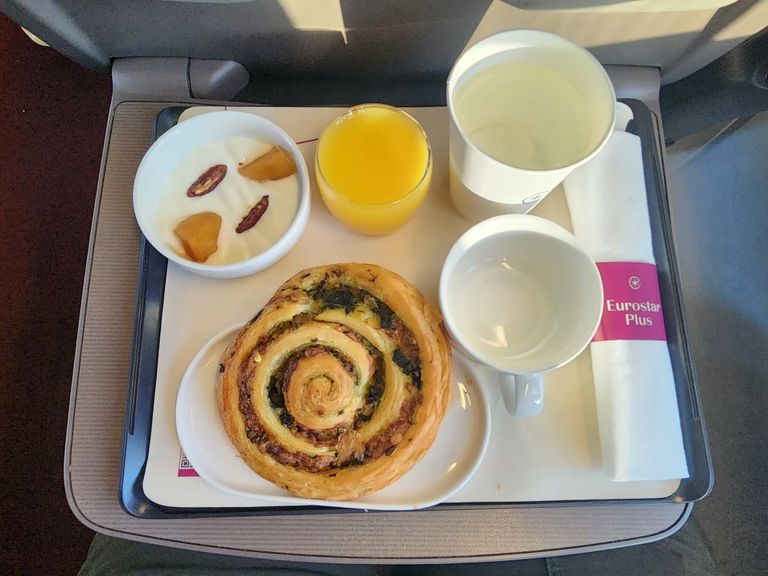
The station experience, the checking-in etc and the ticket terms and conditions are the same as when using and booking Standard tickets.
(26) When looking up departures on a particular date, prices of Plus class tickets can be cheaper on some departures, compared to the price of Standard Class tickets on other departures.
Child tickets
(27) The terms for child tickets for travel by Eurostar are:
- Children aged 12 to 15 at the date of travel are charged the Adult rate.
- Those aged 4 – 11 on the travel date will receive a discount of 50%, but when tickets reach an undisclosed tipping point, the discount will only be 30%
- No charge for those aged three and under, but they won't be allocated a seat.
Note that this is different from the norm when travelling with children on British trains.
Money Saving tickets
(28) On journeys to and from London, if you are happy to:
- book up to 14 days ahead
- not know which specific train you will be travelling by until up to 48hrs prior to departure
- forsake being able to choose a seat(s)
and won't be making a day trip or travelling with children (aged 11 and under), you can save up to 50% by booking Eurostar Snap tickets for travel in Standard Class.
Seat Reservations and Using Eurail and Interrail Passes:
(29) All tickets include a seat reservation.
Using the Seating Plan:
After a booking has been completed, you use the ‘Manage Your Booking’ facility, which can be easily found on the Eurostar website and select specific seats within the travel class you have chosen.
When two or more people are travelling you can use it to ensure that you will be sat together.
You don't need to have booked the ticket with Eurostar.
You will need to enter a Booking Reference number - but other booking agents such as Trainline, Rail Europe, SNCF Connect, B-Europe and NS International, will also include this number on the communication they will send to you.
Travelling with Eurail and Interrail Passes
(30) As all ticket holders have assigned seats, users of Eurail and Interrail passes need to book seat reservations.
Users / holders of 2nd class pass can only book reservations in Standard Class, but those with 1st class passes can book seats in Plus Class - or in Standard Class, if the Plus Class reservations aren't available (see below).
The costs are:
- London <> Brussels, Lille and Paris = €35 for Standard Cass; €40 for Plus Class
- London <> Amsterdam and Rotterdam = €35 for Standard Cass; €43 for Plus Class
- Paris and Lille <> Brussels, Antwerp and Liege = €37 for Standard Cass; €32 for Plus Class
- Paris <> Amsterdam, Rotterdam and destinations in Germany = €32 for Standard Cass; €37 for Plus Class
- Brussels and Antwerp <> The Netherlands* = €22 for Standard Cass; €27 for Plus Class
- Brussels <> Germany* = €27 for Standard Cass; €32 for Plus Class.
*= on these routes these fees can be avoided by taking alternative direct trains.
As is the norm when using Eurail / Interrrail passes, the children aged 4 to 12 will be charged the Adult rate for rail pass reservations.
(31) These reservation fees are more expensive than other mandatory reservation fees, which need to be paid by rail pass users, but they can be great value for money.
The cost per day of using a 5 day 2nd Class, Adult pass + a Standard class reservation can be around €80 less than booking a Standard Class ticket.
The cost per day of using a 5 day 1st Class, Adult pass + a Plus class reservation can be around €100 less than booking a Plus Class ticket.
(32) Interrail / Eurail has introduced a Plus Pass - which includes the cost of up to three Eurostar reservations.
(33) However, rail pass users need to plan and book ahead, because when ticket prices for a specific departure climb to a tipping point, which isn't disclosed by Eurostar, the reservations for Eurail and Interrail users become unavailable, for travel by that train.
On peak travel days the reservations on most departures can become unavailable more than two months ahead!
Onward Connections:
(34) In London King's Cross station is across the street from St Pancras International.
It has trains to / from multiple locations including:
*= this avoids the need to make the comparatively awkward transfer to / from London Euston station.
St Pancras has direct trains from / to Brighton, Cambridge, Derby, Gatwick Airport, Rochester and Sheffield - connect for Manchester
(35) A plus of Bruxelles-Midi / Brussel Zuid station is that Eurostar shares it with other international rail services.
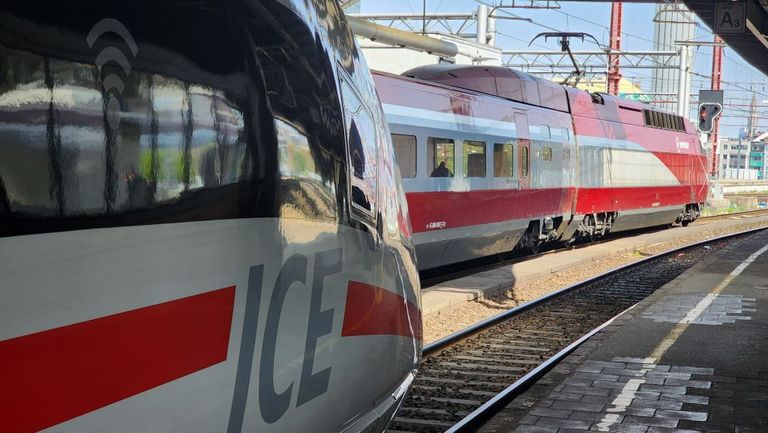
- ICE trains to / from Koln Hbf *, Frankfurt Flughafen and Frankfurt (Main) Hbf - With connections available at these stations in and out of trains to the likes of Berlin, Basel, Freiburg, Hamburg, Hannover, Linz, Munich, Stuttgart, Vienna and Zurich. *= There are also Eurostar trains which travel between Brussels and Koln / Cologne
- TGV trains* to / from multiple locations in France including Lyon, Marseille, Montpellier, Nimes, Rennes and Strasbourg. *= these trains also call at Lille-Europe
- EuroCity Direct trains to and from Rotterdam, Amsterdam-Zuid, Almere and Lelystad.
- EuroCity trains to and from Breda - connect for Eindhoven, s-Hertogenbosch, Nijmegen and Arnhem.
- Nightjet trains to Salzburg, Linz and Vienna.
- European Sleeper trains to Berlin, Dresden and Prague.
(36) Eurostar shares Lille-Europe station with TGV trains which link the city to destinations in France other than Paris.
So making a transfer between these trains in Lille is theoretically much easier than having to make a connection between the Gare Du Nord and other stations in Paris.
However, those in charge of the timetables, have never managed to put together strings of easy connections between the Eurostar and TGV trains in Lille-Europe.
There are transfers available with trains to and from multiple locations, including; Angers, Bordeaux, Lyon, Marseille, Montpellier, Nimes, Rennes and Strasbourg, but the time between arrival and departure is typically around 90 mins.
Also it's typical for only one or two connections in Lille per day to be available.
all images taken by Simon Harper
About the Author
Simon Harper has been writing about international rail journeys for over 10 years.