
Planning A Trip For Seniors: Part 1 - Working out the Where and How
Mum asked if she could come with me on my next European rail adventure and this is how I made it happen!
Table of Contents
Share

Despite my somewhat eccentric claims that most of my previous rail adventures around Europe were not holidays, but were instead research trips for Conductor Sam's parent website, ShowMeTheJourney, my mother wasn't fooled.
Which is why during a Sunday lunch she said, "I'd like to come with you, the next time you go away by train".
That set my mind racing, obviously the three or four cities per day that I usually tick off would be er bonkers, so the trip needed to be manageable and ideally make the most of the trains.
The material for an article, would be a bonus - I had to get Mum to reassure my brother that I hadn't hustled her into the trip, so that I could write it up (ahem).
A different destination per day was all mum's idea, 'because when you take the train you can see more and get to more places'.
Choosing The Destinations
But what would those places be?
Mum wanted to go Continental and take the Eurostar, as the enormity of airports and the hassle of going through security and collecting of luggage has become daunting.
She'd been to Paris and remembered it can be hilly and that the Metro 'means going up and down stairs all the time'.
At aged 81, stairs are heavy on her knees, but walking for 30 mins at a time is fine - as long as it's flat.
In addition to being flat, South Holland ticked a lot of other boxes:
- Direct Eurostar trains from London (our home town) to Rotterdam - And not quite as far as Amsterdam
- Cheaper room rates than Amsterdam - hence we stayed here, a 4* hotel for less than €100 per night, per room! (the price when we booked)
- Less than hour's travel time on to Amsterdam for an easy day trip!
- Multiple pretty towns within easy reach by train
- The opportunity to get to the coast
Discussing the plan, mum said, "Isn't Bruges in Holland? My friend says it's lovely there".
So despite its location in Belgium it was added to the itinerary, after I'd explained that it would be a comparatively easy journey by train from Rotterdam.
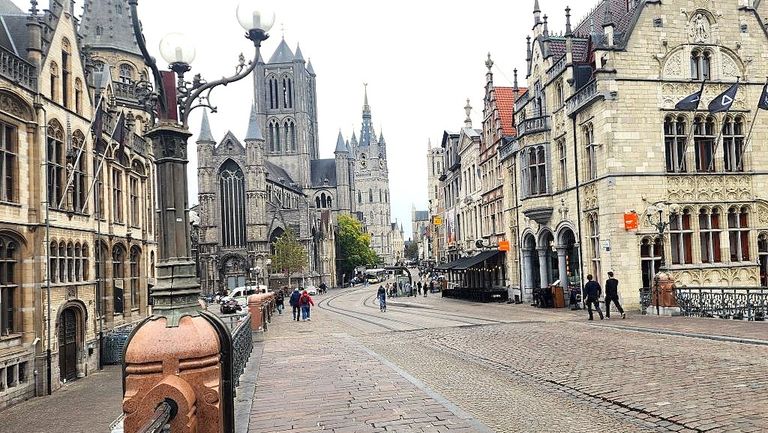
Having decided to stay in Gent rather than Bruges, on a previous holiday to Belgium, and fallen head over heels for the city, mum agreed to the idea that we should do the same.
The itinerary
Now we had a plan to check and confirm, which was:
- London to Rotterdam by Eurostar
- Trips from Rotterdam to Amsterdam, Delft and the Dutch coast
- Rotterdam to Gent by train
- A day trip from Gent to Bruges
- Gent to London by connecting into a Eurostar to Brussels.
Putting The Plan Together
I've made more than a dozen trips from St Pancras International.
Plus my brother, who is registered disabled, had headed to Paris by train for an anniversary trip earlier this year and said that the Eurostar staff had been fantastically helpful.
So boarding mum on to the Eurostar in St Pancras wasn't on the 'things to check' list, but what was, included:
- Confirming that lift / elevator access would be available to/from the trains at every station.
- The public transport connections between the stations and the hotels.
- How easy it would be to travel to and from the day trip wish-list destinations?
- Checking that we would be sat together on every train.
- The cheapest total travel cost - see below
Asking Conductor Sam
Thanks to multiple past trips, I have a good idea of how to travel in Belgium and in The Netherlands by train, but I hadn't previously needed to have front of mind, how a Senior traveller would take trip.
To ensure mum would enjoy her travels, I had to turn assumptions into confirmations.
So the questions I asked Conductor Sam included;
- Does every platform at Rotterdam Central station have a lift / elevator?
- Where is the taxi rank at Rotterdam Central?
- Where can I check info about the trams in Rotterdam?
- What is the nearest Metro station to the Hotel James? Does it have step free access to the trains?
- Is there a day travel pass which covers Rotterdam, Delft and The Hague?
- Is there a discount for seniors on the trains and trams?
- How to to pay for the public transport in Rotterdam, in Amsterdam, in Delft and in The Hague?
- Where can I go within an hour by train from Rotterdam?
- Can we save by booking the Rotterdam to Gent journey in advance?
- What are the restrictions of using the cheaper tickets?
- Should we travel from Rotterdam to Gent via Antwerp or via Brussels?
- Does the main station in Bruges have step-free access to/from the trains?
- How to avoid having to walk from Bruges station to the city centre?
- Which tram routes connect Gent's main station with the city centre?
- How soon do we need to at Midi station in Brussels before the departure of the Eurostar back to London?
So cue blowing of my own trumpet... but Conductor Sam saved me at least an hour of planning time!
General Advice When Planning Journeys to be taken by Seniors
Need to know pre-ticket booking info, such as the availability of alternatives to having to use stairs etc, can be buried deep on rail travel info services.
The alternatives to using Sam, to confirm the availability of lifts / elevators on routes within stations and between street and train, are the Station Info services.
These include the below:
(Click the countries to access the rail station info portals - The included countries have the locations of lifts / elevators and escalators within the stations as standard features)
General Info for Boarding the trains
When I've taken my rail trips around Europe, I'm fortunate that I don't have to give too much thought to how I will get on and off the trains.
I've learnt that when I'm travelling with heavy luggage, a technique for easier boarding is take my pack off my back and swing it, and / or my suitcase, up to the top step of the staircase by the doors.
However, when I have no bags it becomes automatic like pushing open a door; But for my 81 years young mother, it matters - a lot!
I didn't appreciate how much of an issue it would be, so I didn't make it a priority of the planning - and now I know different.
Mum can find getting on and off trains in Britain tricky, because the trains here don't have stairs - But the trains on Continental Europe do have them, so I made an assumption that would make the going easier.
I could have, and now realise I shoud have, also asked Sam for answers to questions such as:
- Which trains in the Netherlands have level boarding?
- Can I avoid double-deck trains when travelling in Belgium?
Britain vs mainland Europe
Some context -Trains in Britain don't have stairs, because the platforms from which the trains can be boarded are built up - So that the idea is that the platform is level with the train doors, for nice and easy access.
But it's a concept that's no longer fit for purpose - Because if there is a standard for how high the platforms should be, it's evident that it's being ignored by the manufacturers and operators of the trains.
"Mind the gap" is close to becoming universal and it's something I keep in mind when planning trips with mum around London on the regular trains.
Over on the continent, boarding the trains is another aspect of rail travel, along with the max height and width of the trains, when other European countries looked at how things were being done in Britain and decided 'Hmm, not for us thanks'.
In pretty much every other European countries the platform heights were kept comparatively low - But the seats on the trains need to be higher than the wheels, hence the steps by the train doors.
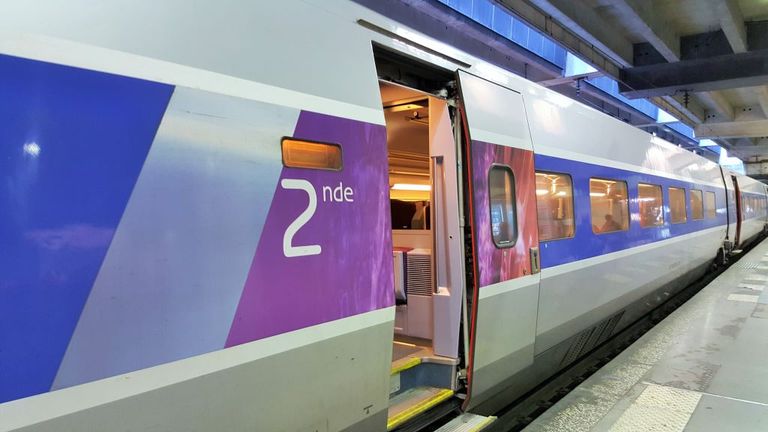
Mum appreciated the steps like these when getting on the trains, she could gradually pull herself up one at a time.
However, getting off was a different story - Standing inside a train door looking down at a platform far below, when she couldn't see the bottom step, was daunting for her.
Trains with 'level boarding'
The train operators and manufacturers across mainland Europe are waking up to the need to make the trains more accessible for those who find steps to be a barrier to travel.
Hence most new trains that have been introduced over the past 5 years have 'level boarding'.
In effect this means that the seats on the coaches between the wheels are lower, so that they can be pretty much the same height as the platforms.
The train doors are then positioned on this lower level.
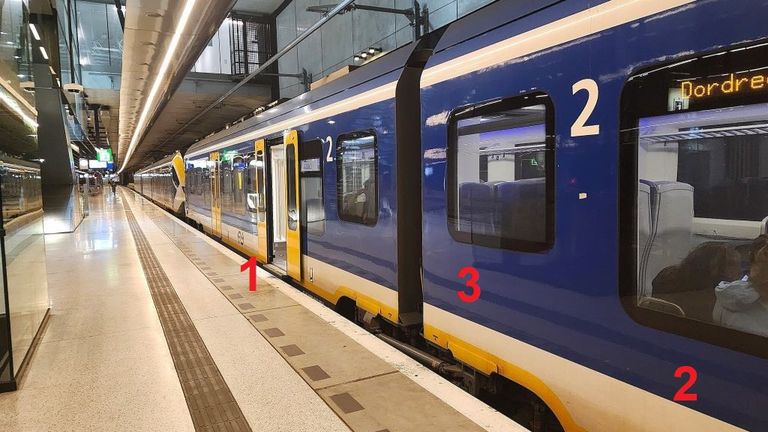
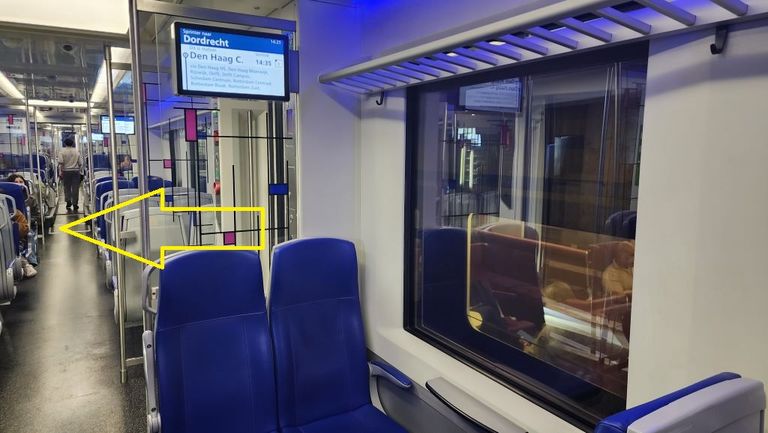
Though an issue when planning a rail trip on continental Europeans for Seniors and other travellers who have impaired mobility, is that these level-boarding trains are comparatively rare.
They are more common on local and regional routes, but 100s of different types of trains are used for these services across Europe - So whether a level-boarding train will be used on a specific departure can be a scenario that Conductor Sam can't answer accurately.
The regional and local services, on which some trains have level-boarding, include;
- the TER services in France
- the Regionale trains in Italy, particularly the Trenitalia services in northern Italy
- most of the Sprinter services, in The Netherlands; these trains are pictured above
- a few Regio services in Germany
- some of the local and Regional-Express train services in Switzerland
- the new InterRegio services in Austria.
- the Tilo services; Locarno <> Milan
Though these trains used for long-distance journeys do have level-boarding, plus they now dominate the routes on which they are deployed.
- ECD trains; main route Bruxelles <> Amsterdam Zuid
- Giruno trains; main route Zurich <> Milano
- IC 2000 trains in Switzerland; main routes Basel and Zurich <> Brig
- ICNG trains in The Netherlands; main routes Breda - Rotterdam <> Amsterdam / The Hague
- Railjet New Generation trains; Munich <> Italy via Innsbruck
- Twindexx trains; main route Zurich <> Geneva via Bern, plus other IC routes in Switzerland
- Traverso trains in Switzerland; main routes, Basel and Zurich <> Locarno
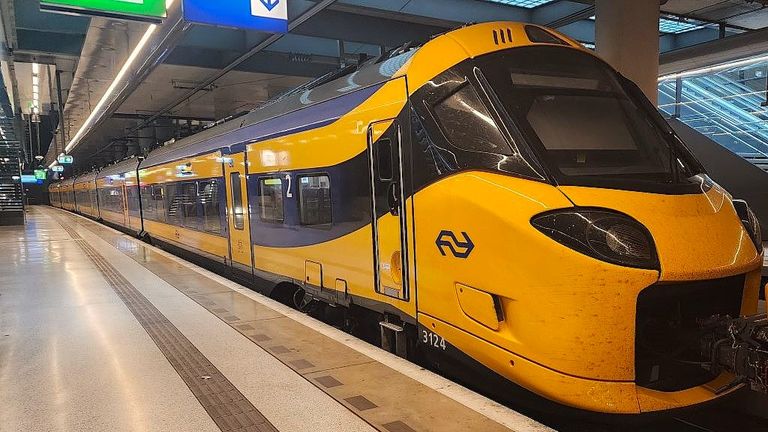
Similar trains to the ICNG trains will soon be used on the IC routes in Denmark,. plus these trains will be operating on some routes in Germany and on the Hamburg <> Copenhagen route.
In Great Britain, theoretically all trains have level-boarding, but as mentioned above, the gap between the doors and the platforms can be so large, that it can negate the advantage to travellers.
Double Deck trains
Double-deck trains have up to three sets of steps - so they can be barrier to easier travel for those who find taking stairs difficult or impossible.
A logical assumption is to avoid the upper deck, but other stairs almost always connect the area by the doors to the lower decks too; Though the double-deck IC Swiss trains are an exception.
Most double deck trains also have steps inside the doors, which have to be used when boarding and disembarking from the trains = they can be especially awkward!
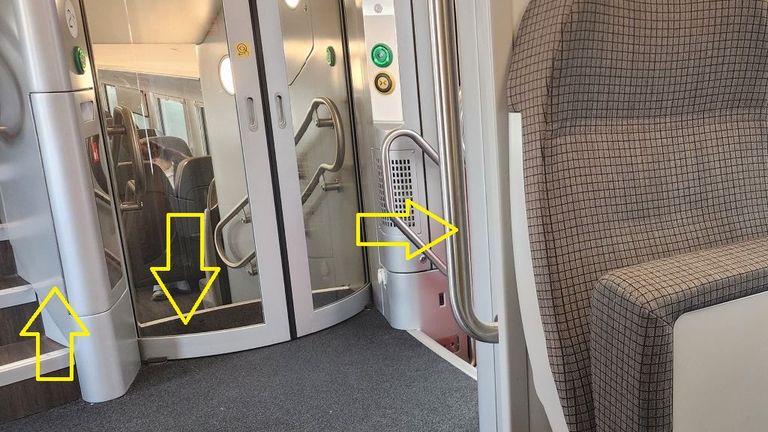
Though this isn't a scenario that always need to be factored in to your travel plans.
Longer -distance express trains aren't double-decked in Britain, Denmark, Italy, Norway, Spain (the Renfe operated services), Sweden or any country in eastern Europe including Czechia and Hungary.
Those which are include;
- Most of the TGV trains in France used on national routes; including all Ouigo services.
- The Ouigo services in Spain
- The Westbahn services in Austria (and now the IC trains on the Wien <> Salzburg route)
- Some of the trains used for IC services in Belgium.
- The Lyria trains between Paris and Switzerland.
- Plus most of the IC services in Germany, Switzerland and The Netherlands.
Note that the ICE trains in Germany are not double-decked
General notes on Tickets and Reservations
If your journey will be easier and more enjoyable if:
- you're sat by the doors
- you can travel on the lower deck, when applicable.
- you want travel any other specific type of seat(s)which can be found on a seating plan
then you'll need to plan and book ahead, because your preferences will be more likely to sell out, weeks ahead of your travel date.
Tickets and reservations usually become available;
- 1 month ahead = Poland
- Up to 2 months ahead = Denmark and Czechia and Hungary
- Up tp 12 - 13 weeks ahead = Norway
- Up to 3 months ahead = Great Britain
- 2 - 6 months ahead = Spain; it is the AVE trains to/from Madrid and the TGV trains between France and Spain that are now available up to 6 months ahead.
- Up to 4 to 6 months ahead = France; depends on the route, tickets now tend to be released sooner on the trains from and to Gare de Lyon
- Up to 4 months ahead = the IC day and night trains in Italy
- Up to 6 months ahead = Austria, the Frecce trains in Italy, Switzerland and Eurostar - on all routes, including to and from the UK
- Up to 6 months ahead = Germany to/from Austria, Czechia, Denmark, France and Poland
- Up to 12 months ahead = Germany; national journeys
- Up to 12 months ahead = Germany to/from Belgium, Switzerland and The Netherlands
- Up to 12 months ahead = Sweden.
When seats can't be booked ahead
Seat reservations aren't always available on European trains and the exceptions include virtually every Regional type of train service or route - despite the long-distances that they can travel.
They are also not on option on the express IC trains in Belgium and The Netherlands, or on the Euro City and ECD trains which travel between the two countries - Though this was a plus on the trip I took with mum!
So if you'll be travelling on such a train and boarding at the station where it commences its journey, be there at least 20 mins before departure.
Then you can be among the first people to board and therefore take your pick of the seats.
Or if there's a train leaving in less than 10 mins, but there's another departing 30 mins after it, on which your tickets will be valid - stop and check the mood of the travel party,
Because hanging back, so that you can be the first to board that later train, can be the way to go.
Connections
On some journeys making a connection between trains can't be avoided.
When taking an indirect route, the ticket agents and other journey planners can steer you towards making the journey in the shortest possible time, with connecting times between trains of 10 to 15 mins or less.
Those connections are ideal for fit and abe travellers, who can easily go up and stairs, or speed up if they're against the clock.
But when you're not able hurry, or need to take multiple elevators in order to get from one train to another, making a 10 to 15 min transfer can be a stress-factor.
So instead take the focus off time and move it to ease.
When planning a trip, check the opportunities, by asking Sam, to take an hour or more between trains.
Use the time to have something to eat, or to shop - many large European stations are in effect mini malls.
Reservations
Using any opportunity to make the journey easier is welcome, so making reservations on trains when it's an option, is the way to go.
European train services, on which you will need to proactively add a reservation when booking tickets, include:
- ECE trains; Zurich ↔ Munich
- Comfort Jet trains
- Railjet trains
- ICE trains (within Germany and to/from Switzerland)
- Trains between Hamburg and Denmark
- EC trains to and from Germany (except during June to August when they are mandatory)
- IC trains in Switzerland and Germany and Austria and Denmark and Sweden
- Lyn services in Denmark
- on express trains in Britain and Norway
When reservations are optional on day trains they are priced at a flat rate per seat - everywhere except for Britain, where there is no charge.
These flat rate reservation fees also apply when travelling with Eurail or Interrail passes - and these passes have a Senior Discount for those aged 60 and over!!!
Day trains with mandatory reservations
A difference to travelling with tickets is that these rail pass reservation fees, are an additional cost when travelling on the train services / routes which have mandatory reservations.
In contrast, when booking tickets for trains with mandatory reservations, there are no additional costs, despite each traveller having a guaranteed assigned seat for the entire journey
Countries with mandatory seat reservations on national express trains: Bulgaria, Finland, France, Greece (but no charge) Hungary, Italy, Poland, Portugal, Romania, Serbia, Spain, Sweden and Turkey (no charge)
International express train routes with mandatory reservations:
Year round:
- Italy ↔ Austria, France and Switzerland
- France ↔ Belgium, Germany, Luxembourg, Italy, Spain and Switzerland
- Great Britain ↔ Belgium and France
- Poland ↔ Czechia and Germany
- Bulgaria ↔ Romania
- Hungary ↔ Croatia and Slovenia
- Estonia ↔ Latvia
June to August:
- Germany ↔ Austria, Belgium, Czechia, Denmark and The Netherlands
Using Seating Plans
The seat numbers in the carriages on European trains can be arranged randomly, but the booking services will typically assign consecutively numbered seats regardless.
Hence in order to ensure that you will be sat in a specific place which will suit you, using a seating plan whenever you are given the opportunity to do so, is pretty much an essential step to take.
When reservations are mandatory the ticket booking paths* usually feature seating plans; Either as a step along the booking path, or with a link offering access to a plan - this second approach is taken by Trenitalia.
Booking tickets for 2nd class travel by TGV InOui trains in France and the high speed trains in Spain, are the most notable exceptions to this.
Access to seating plans are included with the the booking confirmation when taking a Eurostar - So I checked out the seats that mum and I had been assigned.
I moved us to more private table seat in Plus class and to seats by the doors for the return trip in Standard Class.
Seating plans are also available* for some train services on which reservations are usually optional, including:
- ICE trains
- the Railjet trains
- the Azuma trains and the Pendolino trains in the UK,
- plus most Czech express trains
*= You are more likely to have access to a seating plan if you book on the website of the train operator - which is usually the national rail company / organization.
Additional info, including what to look for when booking European night train journeys, is available on these sister articles.
Booking Our Trip
I've been asked to produce multiple bespoke travel plans for clients whose trips has involved taking the Eurostar train both from and to London.
So I knew that it would be worth treating mum like a client and making a comparison between tickets vs Interrail Passes + reservations for our rail adventure.
Plus I thought it would be kind of cool for mum to make her first Interrail trip aged 81! And she'd save on the pass by being aged 60 and over.
With the mandatory reservation fees for using Interrail or Eurail passes on the Eurostar trains from and to London being €35 to €40, hence an additional cost to be added to the pass price - it seems counter-intuitive to even consider a pass, for the comparatively short trip we'd be taking.
After all we could have used the pass for valid for 5 days to make a return trip to the likes of Rome or Malaga.
Making the comparison between passes and tickets
However, for the 5 day passes*, I needed to factor in the cost of using the pass for a day's travel + the Eurostar reservation fees, which gave a total Interrail one way cost of around €85 for 2nd class travel; And around €100 for 1st class travel.
* = passes valid for longer periods have cheaper costs per day
But one way tickets for travel from and London by Eurostar can cost more than that - Particularly as the tickets had already been on sale for 3 months, by the time I'd started to plan our trip.
A project that's been worked on at the moment, is for Conductor Sam to have the capability to more accurately compare whether tickets or Interrail / Eurail will give the best value for money, when planning an itinerary.
I asked in any case and sure enough Sam in effect told me that there was a good chance that Interrail would be the winner.
To be sure I had to crunch the numbers of the price per journey, by using Trainline
Despite the cost per day of using Interrail for the days of Belgian and Dutch travel, being more expensive than the tickets - Interrail won out!
The total difference was only around €20, but a pass would also have made the going a tad easier - Especially as booking rail pass reservations isn't something that needs to be factored in when planning to use Interrail or Eurail on Belgian and Dutch trains.
However, just before booking we decided to move the entire holiday back a week, which enabled me to find Plus Clas (1st class) single tickets to Rotterdam for only £81 each - And Standard Class tickets from Brussels for £60 each.
This made a crucial difference in tipping the balance to tickets instead; So mum is yet to experience the joy of Interrailing.
About the Author
Simon Harper has been writing about international rail journeys for over 10 years.