
Planning Tips for Small Groups of Rail Travellers
How to make the most of exploring Europe by train with a small group of friends or relatives by having an easier trip
Table of Contents
Share

Inspired by the 'conversations' Conductor Sam has been having with its users, these tips and suggestions for travel parties of small groups of adults have been brought to the surface.
Because what's become clear is, if you are new to European train travel, the questions, trepidation and excitement around the trip, increases in line with how many people will be travelling together.
Hence this summary of how Sam has been answering those questions.
It will will now also assist with its ability to help other future travellers, by providing an info source that it can use.
Putting The Trip Together
- The planning process will be easier if one individual takes the role of the lead booker / planner and holds the casting vote on which locations you do and don't include on the itinerary.
- You don't have to travel together on every journey and route, even if you will be travelling with Eurail or Interrail - Passes are issued to individuals and not the group, so each member of the party will have their own pass on their mobile device, to which journeys can be assigned.
- Therefore if some members of the party want to take a more scenic, but longer route, but others would rather reach the day's destination as fast as possible, the group can divide. Popular journeys between A and B when this type of decision can be made include: Zurich ↔ Milan; and Cologne ↔ Frankfurt / Stuttgart; and Bern ↔ Milan and Munich ↔ Innsbruck
- You can also stopover in different locations while on route from A to B. For example, If one or two members of the party have the German National Railway Museum on their bucket list, they can stop over in Nurnberg, while everyone else stays on the direct train to Berlin, Hamburg or Munich.
- It can be easy to under estimate how long it will take to travel between A and B on European trains, so checking off everybody's destination wish list is likely to result in some compromises. European rail journeys that in effect require a full day, of more than 8 hours of travel, include:
- Rome ↔ Geneva, Marseille, Munich, Paris, Vienna and Zurich
- Paris ↔ Berlin, Hamburg, Madrid, Rome, Venice and Vienna
- London ↔ Barcelona, Berlin, Hamburg Milan, Munich and Nice
- Amsterdam ↔ Basel, Copenhagen, Marseille, Nice, Prague and Salzburg
- Berlin ↔ Basel, Paris, Salzburg, Vienna and Zurich
Many of these long daytime routes are also covered by overnight trains (as per the Table of Contents), but there also some gaps in the European night train network, including:
- Paris ↔ Italy, Spain and Switzerland
- Amsterdam ↔ Denmark, Italy and Poland
- Rome ↔ France and Switzerland
.jpg?width=768&resize=contain&quality=80)
Locations
Where you choose to stay can make an entire trip both easier to plan and easier to manage, once you have embarked on the itinerary together.
The trick is to have an extended stay or two, in towns and cities from which it's simple to take day trips by train to a multitude of other locations.
It can tick multiple boxes:
- Access to different types of scenery and experiences which can tick off some of the collective wish-list.
- You can split for the day and head to locations that suit some, but not others.
- Finding your way to where you'll be staying can be the most awkward aspect of an itinerary, so this cuts that down.
- Easy day trips on frequent trains which don't need to be reserved, or given much thought all, makes the planning easier.
- More opportunities to be spontaneous.
For example, Marseille might not be on any member of the group's must see list, but it can be used as base for day trips by train to a swathe of stunning locations, such as Arles, Avignon, Aix-en-Provence, Nimes and the Cote d'Azur.
Other cities / towns which offer at least four easy day trips by train to somewhere worth visiting include Brussels, Edinburgh, Erfurt, Innsbruck, Leeds, Manchester, Munich, Offenburg and Stirling.
Or you can probably also save on accommodation fees, by making these swaps to generally cheaper locations that also make great bases for exploring by train:
- Gent instead of Brussels or Brugge
- Glasgow instead of Edinburgh
- Bologna instead of Florence
- Vicenza instead of Verona
- Rotterdam instead of Amsterdam
- Olten instead of Basel, Bern or Zurich.
Switzerland
This notion of spending nights together, so that you can explore by day, works particularly well in Switzerland.
The country has multiple railway hubs from which pretty much the entire country can be reached by train, such as Basel, Bern, Luzern, Olten and Zurich.
While the likes of Chur, Interlaken, Lausanne and Locarno allow for easy exploration of spectacular and different regions by rail.
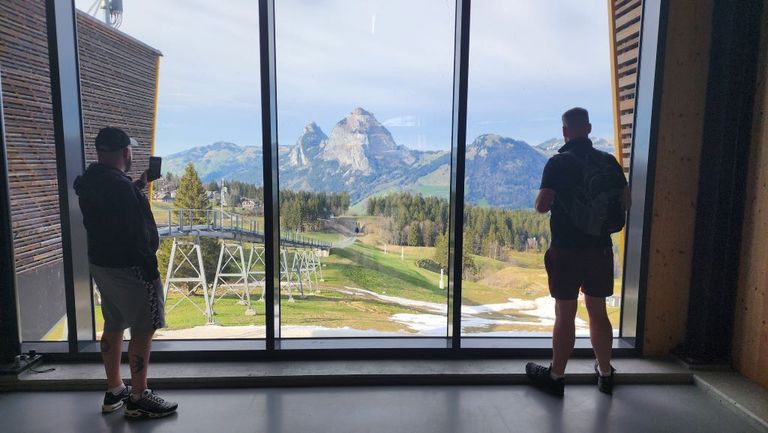
If some of the party enjoy hiking, while others would prefer to gaze across the mountain tops from a cafe at a summit station, then Switzerland lends itself to quality time apart from other members of the group.
More than once I've found myself having a beer or two after a train ride, while waiting for friends who were heaving themselves up a path way - and a quality experience was had by all!
On the daytime trains
The majority of seats on European long-distance day trains are now airline style, meaning that they are in rows and face the backs of the seats in front.
Those that are responsible for managing and designing high-speed trains tend to universally hold a view of, 'wouldn't it be great if we make trains as much like planes as possible'.
So those airline style seats aren't particularly social, they're perfect for those who want to put a laptop computer on a pull-down shelf, but not so great for conversations, playing cards or other games etc.
However, alternative seats, which are better suited to small groups, will usually be available, hence these tips for finding them.
Compartment seats
For those they want to chat during a journey, being in a seating compartment can spark a conversation with other travellers sharing the compartment, creating the type of experience that can't be enjoyed on a plane.
However, compartment seats are becoming ever rarer when taking trains in Europe, as most trains introduced over the past 10 to 15 years either have none, or only one or two for use by families with small children - which is the situation on the ICE trains.
They are therefore not an option when taking AVE trains in Spain, Frecce trains in Italy, or TGV trains in France.
No British or Dutch trains have compartment seats, but they are more common in eastern Europe.
Hence many express trains in Czechia, Poland and Slovakia have them, these will be the IC or EC trains - and it can be worth targeting them on seating plans - See below for for how to do this.
If compartment seats will be your preference it can be worth targeting slower trains in order to have a more pleasant journey,
The InterCity trains in Italy and the Intercités trains in France have them, partially because they are not high-speed trains.
Table seats
Seats around tables, which can particularly suit groups of four people, are available on all long-distance trains, but they can be few in number.
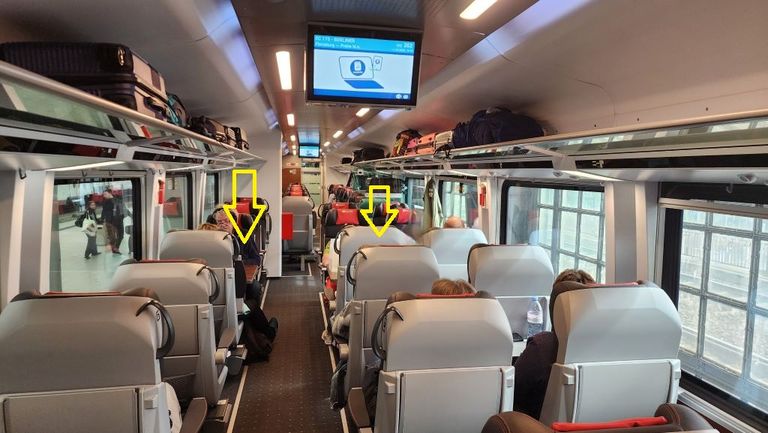
Because, what's becoming the norm for 2nd class coaches on express trains is that there are only a few table seats in the middle of the coach, with all of the other seats arranged airline-style.
Hence it can be worth booking early to secure them.
Though this isn't universal, some new trains, particularly in Switzerland, have actually brought back the idea that seats are best in groups of four.
To give first class coaches an aura of space and comfort, they nearly always have more seats at tables than second class coaches.
So easier access to table seats can be a less obvious benefit of opting to travel in first class.
Restaurant cars
A comparatively small number of European express trains still have separate restaurant cars at which four people can sit together at a table and have a meal - regardless of whether they have booked 1st or 2nd Class tickets, or will be using 1st or 2nd class rail passes.
Trains which offer this service include Railjet trains, all types of ICE train, the IC trains in Switzerland and most EC trains and services.
Though a dedicated restaurant service is not available on the national trains in Belgium, France, Italy, Scandinavia, Spain, The Netherlands and the UK.
Seats in the restaurant cars cannot be reserved.
So on a train with mandatory reservations, if you know that you will want to dine during the first stage of a journey, it can be a good idea to board directly into the restaurant car, so that you can secure a table
An advantage of being in a group is that one of you can board into the restaurant car and check what the scenario is.
However, on a train with optional reservations, even if you have reserved, it's best to board and claim your seats, so that other travellers without reservations don't assume that you haven't boarded and will therefore occupy your seats.
Also in this scenario the party will need to divide, so that some members of the group can keep an eye on the luggage and seats, while others are away from your seats having a meal.
Seats with a meal service
Another less obvious benefit of travelling 1st class is that on most of these trains with restaurant cars, including the ICE trains and the Railjets, you don't have to go to the restaurant cars in order to enjoy the full meal service.
Instead you can order from the full restaurant menu and an attendant on the train will bring the food to you.
So the ultimate small group rail travel experience is to reserve four seats around a table in a 1st class seating area and then have a meal during the journey.
You can relax and not worry about being able to keep an eye on your luggage, or whether a table in the restaurant car is available.
However, if these or those other types of seats, will matter to your journey, you will need to take the necessary steps, in order to ensure that your on board experience will match your preferences.
Hence the top tip being - book ASAP whether you will need tickets or rail pass reservations.
Booking the Daytime trains
Aside from the national express trains in Belgium and The Netherlands long-distance day trains in Europe have either optional or mandatory seat reservations.
When reservations are mandatory
When reservations are mandatory the ticket booking paths usually feature seating plans; Either as a step along the booking path, or with a link offering access to a plan - this second approach is taken by Trenitalia.
Booking tickets for 2nd class travel by TGV InOui trains in France and the high trains in Spain, are the most notable exceptions to this.
Most importantly for travel by small groups, these seating plans show the locations of the table seats and compartment seats (when available).
If being sat together around a table would be your preference, you'll need to use the seating plan to select these seats.
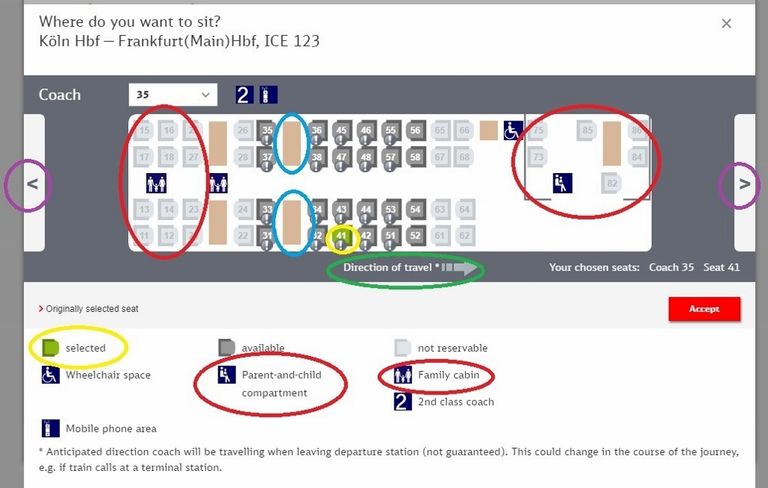
The ticket booking and reservation services won't automatically seat you together, despite multiple people being included on the same booking.
The seat numbers in the carriages on European trains can be arranged randomly, but the booking service will typically assign consecutively numbered seats regardless.
So even if you don't want table seats, but would like to be sat together, using a seating plan, to pick the seats which would suit you, is highly recommended when travelling in a small group.
On some booking services including Eurostar, you will given the opportunity to pick specific seats after you have booked.
When reservations are optional
Arguably the biggest quandary when travelling by train in Europe is whether to reserve or not when it is optional.
Because when reservations are optional on European trains, the number of tickets sold won't be limited to the number of seats.
So it can be possible to board without a reservation and discover that no seats are available.
In my experience opting to reserve is less crucial when travelling in First Class or its equivalents.
Though my rule is to reserve in First Class regardless when I find myself in these scenarios:
- When boarding at an intermediate station on Friday and Sunday afternoons / evenings.
- If I will be travelling for more than three hours
- If the train I'll be taking is on a particularly infrequent route.
- If I will be departing between 9am and 2pm on Saturdays during June to August
- When travelling on the days either side of public holidays.
When travelling in 2nd class I apply all these terms to myself, plus;
- Taking any journey on Fridays
- Any Sunday journey between 1pm and 7pm
- Any route in June to August on which the frequency of the trains is every two hours or less
However, when travelling in a small group, searching through a carriage, or moving through a train, in order to find available seats, won't be practical.
Hence always making reservations for these trains, despite the additional costs of doing so, can be the way to go.
When boarding you may discover that the carriage / train is close to empty and wished you hadn't bothered and regret the expenditure - but there are no 'hard rules' that can applied to the trains with optional reservations.
On routes with comparatively frequent services, the trains can be less busy on Sunday mornings and in the early afternoons on Monday to Thursday.
However, opting not to reserve can be a gamble whenever you will be travelling.
And if keeping the group happy means being together on the trains which leave at popular times, then reserving when you don't have to, will be a big win!
Seating plans, which will enable you to target table or compartment seats, are available for many train services on which reservations are usually optional, including:
- ICE trains
- the Railjet trains
- the Azuma trains and the Pendolino trains in the UK,
- plus most Czech express trains
Booking Ahead
Regardless of whether the seat reservations are mandatory or optional, the seats on the most popular trains can become fully booked days or weeks ahead of the travel date.
The trains marked with * below are those on which seat reservations for rail pass users can be sold out, despite tickets still being available to other travellers.
The train routes and services, on which some departures can sell out completely ahead of the travel day, include:
- Eurostars from and to London*
- Summer journeys on the TGV trains in France and other high speed trains to/from France
- the AVE and TGV trains between France and Spain*
- Eurostar trains between Amsterdam, Bruxelles, Cologne and Paris, particularly on Fridays
- TGV trains between Bruxelles and France*
- Snabbtåg trains in and to/from Sweden on Friday and Sunday afternoons
- Summer journeys by Italian Intercity trains
- The Frecce trains on routes in Italy that have less frequent services
- Trains between Paris and destinations south of Lyon on Fridays and Sunday afternoon / evenings year round
- Germany ↔ Czechia trains in June - Sept and on on Fridays and Sunday afternoon / evenings year round
- Germany/Austria ↔ Italy trains in June - Sept and on on Fridays and Sunday afternoon / evenings year round
- on any express train on the days either side of national holidays
If travelling together matters to you, so you'll want to reserve a group of three, four, six seats etc, you'll need to get ahead of the game.
On many departures and routes, less than 10% of all the seats on the trains are at tables, so they inevitably become among the first to be chosen.
Tickets and reservations usually become available;
- 1 month ahead = Poland
- Up to 2 months ahead = Denmark and Czechia and Hungary
- Up tp 12 - 13 weeks ahead = Norway
- Up to 3 months ahead = Great Britain
- 2 - 6 months ahead = Spain; it is the AVE trains to/from Madrid and the TGV trains between France and Spain that are now available up to 6 months ahead.
- Up to 4 to 6 months ahead = France; depends on the route, tickets now tend to be released sooner on the trains from and to Gare de Lyon
- Up to 4 months ahead = the IC day and night trains in Italy
- Up to 6 months ahead = Austria, the Frecce trains in Italy, Switzerland and Eurostar - on all routes, including to and from the UK
- Up to 6 months ahead = Germany to/from Austria, Czechia, Denmark, France and Poland
- Up to 12 months ahead = Germany; national journeys
- Up to 12 months ahead = Germany to/from Belgium, Switzerland and The Netherlands
- Up to 12 months ahead = Sweden.
The use of 'Up to' is because tickets can't be released until the new timetables are confirmed and they have major annual update across Europe on the second Sunday in December.
So when looking up journeys during August / September, it won't be possible to book journeys on dates after the second Sunday in December.
Boarding the trains
Another plus of making reservations is that you'll able to find your seats more easily.
At many stations the platforms that can be used for boarding are split into zones / areas.
There will be info at the station that can tell you where to wait for easy boarding into the carriage in which your reserved seats are located.
This info is most commonly found on the electronic departure info screens on the platforms - it is in Germany, France and Switzerland and at some stations in Great Britain.
In Austria there will be screens showing the formations of the next three departures.
In Italy the numbers of adjacent carriages for the next departure will appear on red screens.
Though in Spain you need to look out for paper posters in the pre-boarding waiting areas.
There will also be seat numbers by the doors on the exterior of many carriages - which in effect indicate use this door to access these seats.
Boarding without a reservation
If you couldn't or didn't reserve and you will be boarding at the station in which the train will be beginning its journey, it's a very good idea to be at the station a minimum of 30 mins pre-departure.
You can then be among the first people to board, so will be able to take your pick of the available seats.
Though at least one of you will need to keep a close eye on the departure screens in the main hall or concourse, you'll usually need to look out for when the specific platform / track number appears.
There are rarely announcements along the lines of 'the train to x is now boarding at platform y' etc
Also if there's a train leaving within the next 10 mins, but there's another train* 30 mins later, hang back and take the second train - especially if you have luggage.
Most of the best seats and optimum space for bags will already have been claimed on that next train to leave.
*Though in most countries including Austria, France, Germany and Italy, it will need to be the same type of train which matches your ticket / reservation.
If you will be joining a train at an intermediate station it can be worth asking for recommendations on how to board at the information desk.
When taking a train in Britain, Belgium, Switzerland and The Netherlands, it can be worth separating yourselves from the crowds, which will tend to gather around the first departure screens that can be found on the platform - move down to the second or third screens.
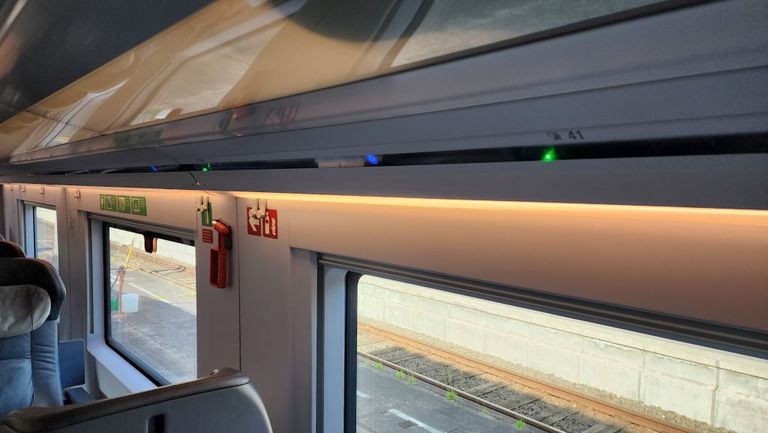
Many of Europe's most modern trains on which reservations are optional, use a system of lights by the seat numbers;
- Green = this seat hasn't been reserved at all, so will be available for the entire journey
- Orange = this seat has been reserved between some stations during the journey, so it might now be available
- Red = this seat has been reserved for the entire journey.
Managing Luggage
It can a be a good idea to have a division of labour, task one or two people with finding the seats and the others can be in charge of stowing the bags.
On most express trains, the spaces which can accommodate medium sized bags are either the racks / shelves, most of which will be by the doors, or the spaces between the seat backs.
The spaces above the seats tend to be smaller than the luggage bins on airlines. Hence they can't be used for items much larger than those within the no charge limits for carry on bags on airlines.
So space for luggage bags can be trickier, particularly when boarding at an intermediate station, hence one of my golden rules is never walk by a space in which you can fit a bag.
You might be able to move the bags post-departure, but if you're not comfortable with where you have had to out them, you can always designate one of the party as a luggage monitor, who can keep an eye on things when the train calls at other stations.
Also don't be afraid of meeting some sort of standard of etiquette.
There's nothing wrong with calling out a message along the lines of "It's OK Bob, there's actually a lot of luggage space around our seats. Bring the bags down here."
Though yet another less obvious advantage of opting to travel in first class in a small group, is the additional luggage space.
More often than not there will also be designated luggage storage in the middle of the carriage, which will also make it easier to keep an eye on the bags.
Taking the night train / sleeper train
On most international EuroNight routes / services and the older Nightjet trains, when all of the accommodation options are still available, there will be a choice of travelling in:
- seats, as on the daytime trains
- couchette compartments with four beds and six beds
- a sleeping cabin which can be occupied by up to three people
- a sleeping cabin which can be occupied by up to two people
- a sleeping cabin for solo use
The sleeping cabins can be offered with and without in cabin showers.
Otherwise the sleeping cabins for one to three people are the same, one bed will be folded out of use for 2 people occupancy; And two beds will be folded out of use for solo occupancy
On the newer type of Nightjet train, there will be a choice of travelling in:
- seats, as on the daytime trains
- a berth in a couchette compartments with four bunks
- booking an entire couchette compartment for 'private' use by 3 or 4 people
- a Mini-Cabin, which in effect is a small couchette for private use by one person
- a place in sleeping cabin to be shared by up to two people
- a place in a Plus sleeping cabin with a shower, to be shared by two people.
Though other night trains, particularly on the national routes, offer different combinations of accommodation choices.
On all sleeper trains, the fewer the number of people sharing a couchette or sleeping cabin, the higher the price per person.
However, as a group you'll need to decide ahead which of these accommodation types will suit you.
This is because when you book, you will tell the website how many people will be travelling together, but you can only then choose the one type of accommodation per booking.
So when booking tickets or rail pass reservations, in effect you will be saying to the ticket agent - 'we will be travelling together on this train and we all want to travel in seats, or couchettes or sleeping cabins'.
Therefore if, for example, a party of six people will be making the journey, and:
- Two members of the party will be happy to pay a cheaper price to travel in the seats
- Two people will be happy to share a couchette with other people outside of the group
- One person wants to travel in a Mini-Cabin
- One person wants to travel in a sleeping cabin
You will need to make four separate bookings, taking care to ensure that you are all selecting the same train.
Travelling in couchettes
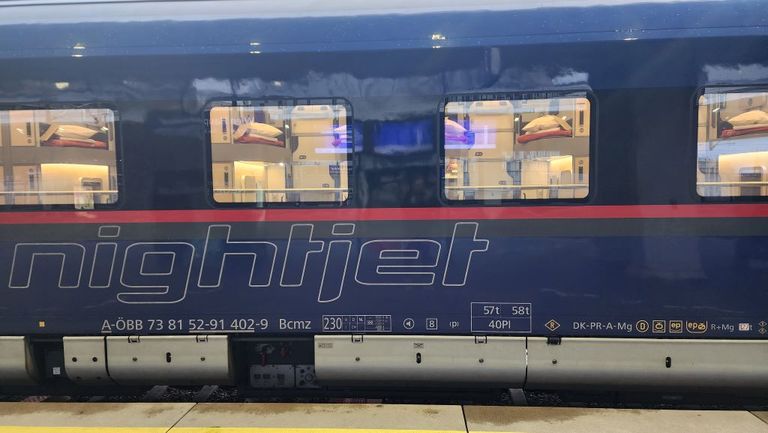
Couchettes are compartments behind a door which house 4 to 6 beds with pillows and sheets, because travellers remain in their daytime clothes; No toilets, sinks/basins or showers within the compartment.
The new type of Nightjet trains have Mini-Cabins for solo occupancy.
Booking berths in a couchette is typically simpler than booking sleeping cabins when a small group want to travel together.
A group of four travellers can choose a couchette with 4 berths, or a group of six travellers can choose a couchette with 6 berths (when available) and you often won't have to share it with anybody else.
Males and females can travel together in couchettes, so that isn't an issue if a mixed sex group wants to share; Though on many trains, including the Nightjets, ladies only compartments are also available.
Travelling in a couchette in in a group of five is a tad trickier -Because when a 6 berth compartment is available, that remaining sixth berth may be offered to another solo traveller; if booking a private compartment isn't an option.
Plus more obviously, when only a 4 berth compartment is available, the fifth (and sixth) person in the party, will have to sleep in a separate compartment.
A party of three will almost certainly be sharing the compartment with another passenger (s).
Though what can't be guaranteed is that you will actually be sharing the couchette together, despite the multiple people all being included on the one booking - Even if the number of people matches the number of places in the couchette compartment.
Particularly on popular trains, it seems that places assigned are front to back along the length of the coach/car.
Compartments are not left vacant on the system, in case a party of four or six ultimately wants to make a booking.
Which is why on the Nightjet trains you will now need to pay a higher cost specifically book a 'private compartment,' when available, in order ensure that you won't be sharing 'your' couchette compartment with anybody else.
Or you can all opt to book Mini-Cabins.
Travelling in Sleeping Cabins / Compartments
Compartments behind a door which house 2 to 3 beds, which can also be occupied by solo travellers, with full bedding of blankets / duvets; Sinks/basins included in all compartments, some also have toilets; Deluxe/Comfort cabins also have showers.
On any European night train a sleeping cabin has a maximum number of three beds.
When booking for Nightjet journey, you can choose between places in;
- Two or three bed compartments (no 3 bed compartments on the new Nightjets)
- Two or three bed compartments with showers (on the new Nightjets the Comfort cabins with showers only have two beds)
- Ladies Only versions all types of compartments
- All members of the party can opt to traveller in 1 person compartments for private use (the other beds in the compartment, will be folded out of use, or left vacant).
If all members of the party opt for the same type of accommodation, all of the travellers can be included on one booking.
Therefore logic suggests that
- when a small group will be travelling together on the same train,
- and they all want to travel in the same type of sleeping cabin
that it should be possible for the travellers to assign the cabins into whatever configuration suits the group when booking.
However, this isn't possible, as the only steps are:
- tell the booking service how many will be traveling
- choose one accommodation type
- and then most typically, but not always, you enter the sex, age and names of the travellers.
What doesn't happen pre-payment is being told you will be travelling in x, y or z cabins.
So you don't get an opportunity to say, 'this person + this person want to be together in cabin x' etc.
Logic also suggests that if, for example, a party of six wants to travel in two bed compartments / cabins, that three cabins will be assigned to the group (3 x 2 = 6) and then on boarding, you can decide who will share each compartment.
However, this scenario can't be guaranteed - And if it isn't the case,, you may not be aware of the situation until you board.
This is, for example, because there will be a possibility that at the time of your booking, that only 4 x two bed compartments / cabins on the train, still had places available.
However;
- Only two of them may be wholly unassigned, so have two places available each = for 4 of the travellers in the group.
- One of them may have one place already reserved by a male solo traveller.
- The fourth may have once place assigned to a a female, who has selected a place in a 'Ladies Only' compartment.
So if your party of six has a female traveller, they will be assigned the second place in the Ladies Only compartment.
One of the men will be assigned the other place in the cabin already booked by the solo male traveller.
With only the remaining two compartments, left to be split between the other four members of the group.
Book Ahead
Not being placed together in the same compartment(s) or cabins is a much less likely scenario if you book as far ahead as possible.
The booking periods will be similar to those above for the day trains - Though maintenance work on the railway networks can impact more heavily on night trains, because of the long routes they take.
Tickets and reservations inevitably can't be made available when this work causes the cancellation of a night train departure - And if you can't see a train / route you want to take on a booking service, this will be the most likely reason.
However, by booking ahead you will be likely, in effect controlling how you will share the accommodation.
For example, if a party of four makes the first booking for 2 x two person sleeping cabins on a departure, then that group will be assigned two cabins - two people per cabin.
Booking ahead makes it more likely that a 'private couchette' for use by a group of four will still be available.
Similarly on the trains which have them, if you all want to travel in Mini Cabins, the sooner you book, the more likely it will be that you will be placed in adjacent cabins - the cabins have sliding screens, which when pushed back, create a two person cabin.
Routes
So taking the night trains as small group can't have its hurdles to get over, plus if you want to travel in the sleeping cabins, it will be comparatively expensive - The reservation fees for sleeping cabins can be more than 6 x the cost of daytime trains at the time of booking.
However, taking the night train can make an itinerary much easier by simplifying the exceptionally long-distance journeys.
The night / sleeper trains provide the only direct links on these popular routes:
- Vienna ↔ Amsterdam and Bucharest and Florence and Hamburg (for most of 2026) and Rome
- Munich ↔ Florence and Krakow and Rome and Warsaw
- Zurich and Basel ↔ Amsterdam and Dresden and Ljubljana and Prague and Zagreb
- Amsterdam ↔ Basel and Prague and Vienna and Zurich
- London ↔ Fort William
- Milano ↔ Sicily
- Sofia ↔ Halkali (for Istanbul)
About the Author
Simon Harper has been writing about international rail journeys for over 10 years.