Planning Tips when Travelling with Children on European Trains
The practical info that is good to know about tickets and reservations when travelling with kids on European trains.
Table of Contents
Share

I don't have children which is why I asked a Travel writer who regularly travels with their kids on European trains, to produce some great tips and advice on how to make the journey experience easier and more enjoyable.
It's also why the image at the top of the page was taken by Lena Plishko and downloaded from Unsplash.
What I can help with is guiding travellers towards booking tickets and reservations when planning how to take you and the kids from A to B on European trains.
Because it's an aspect of European rail travel that varies according to the journeys you will be taking.
The idea is that Sam can now also pick up this info more easily, so that it can help make the journeys happen, by answering kids on trains questions with top marks.
Because if your child is as thrilled by trains as I was, they will love the trip you put together.
The Inspiration
When I was taken home by my parents by train from a trip to central London, I would stand at Victoria station fascinated by the departure board listing destinations such as Amsterdam, Cologne, Milan and Nice.
I didn't fully understand what I was seeing, but neither did my parents, so being taken on a train (and ferry) journey to a distant land, would have felt like going to the moon.
If I was aged 9 today I'd be beside myself if I was taken on a train ride in France, Belgium, Switzerland, Italy or anywhere.
Hence here's how to make that a reality for you and the children in your life!
The ages of the children
When planning a trip with kids on European trains the most crucial piece of information to have front of mind is, how old the children will be on the date on which you will be making the journey(s).
Growing up in Britain where kids under 5 travel for free - And those aged 5 to 15 travel at 50% on whatever price is being charged to Adults for each journey, I'd assumed those age limits were universal.
After all the T&CS for kids on Britain are one aspect of taking the trains here which seems wholly logical; Because it matches the ages at which children have to be attending schools.
However, it wasn't until I was fairly deep into publishing ShowMeTheJourney that I realised that a child's age is one of the oddest aspects of European rail travel - As there is no universal standard at which child ticket terms apply per country / operator of the trains.
Discounted Tickets
Children typically* save 50% on the Adult ticket prices at the ages shown below when travelling on European trains:
*= exceptions can apply between different train operators, including when cities manage local rail networks;
- Finland - aged 4 to 17
- Norway - aged 4 to 15
- Great Britain - aged 5 to 15
- Slovenia, and Switzerland - aged 6 to 15
- Italy (Trenitalia's express trains) - aged 4 to 14
- Austria, Czechia, Germany, Hungary and Slovakia - aged 6 to 14
- Spain - aged 4 to 13
- Greece and Portugal - aged 4 to 12
- France, Italy (regional trains) and The Netherlands - aged 4 to 11
Above these ages the adult rates apply to tickets, but below these ages children travel for free - Though usually, but not always, these younger children have to share a seat with an Adult.
Other countries have more specific terms.
Belgium
If you have young children exploring Belgium by train as a family is fantastic value for money!
Each adult (12 and over) ticket enables up to 4 accompanied children age under 12 to travel for free, in both 1st class and 2nd class.
Though be aware that you will need to be able to provide proof of the age of the children to the conductor - so take their passports with you on journeys within Belgium.
You don't need to book these 'free' child tickets - the adult ticket will be valid for the children too.
Denmark
Book tickets on the DSB website for long-distance journeys and up to two children under 12 years of age, can travel with each adult ticket holder free of charge; plus those aged 12 to 15 travel at 50% of the adult rate.
The rules around travelling with children on shorter distance journeys vary according to region, but in general they equate to free travel for those aged 11 and under /under 12 and at around 50% of the adult rate for children aged 12 to 15.
Poland
Note that there's no specific age limit for child travel on trains in Poland, because in Poland 'students' of any age from 4 to 25 receive a 51% discount, but it only applies to Polish children - because they register for a discount through a school / place of study.
Sweden
On trains provided by the national rail operator SJ, the standard child ticket policy is that kids aged 0 to 15 are given a 15% discount on the Adult rate.
However, if an Adult aged 16 and over accompanies the children and 2nd class tickets are purchased, the Family Offer applies.
This enables two children to travel on day trains for only 15% of the adult fare.
On the SJ Night train, the Family Offer allows two children, aged 7 to 15, travel at a 50 % when booking places in a couchette or 2nd class sleeping compartment.
Children 0-6 years old don't need a ticket if they share a bed with an adult - and don't count as one of the two children in the family offer.
Saving Money When Travelling With Kids
In addition to the cheaper tickets which automatically apply within the age limits listed above, there are also many long-standing deals which are available when a travel party comprises both adults and children.
Austria and Germany
When an adult (a person aged 15 and over) books the cheapest type of ticket for long-distance journeys, both within and from / to both Austria and Germany, up to four children aged 14 and under to travel for free with the 'Adult'.
It doesn't matter if the Adult books 1st or 2nd class tickets.
These cheapest type of tickets, which can't be refunded or exchanged, are the 'Sparschiene ' tickets, which in Austria are now also known as Non-Flex tickets.
Czechia
For travel on a Saturday or Sunday, CD, which is the national rail operator, sells Group Weekend Tickets - a Skupinová víkendová jízdenka.
These can be a great deal when travelling with kids, because up to three children aged under 15 can travel with up to two adults, with the entire party being covered by the one ticket.
France
When travelling on the low cost Ouigo trains a flat rate price is charged for children aged 11 and under of €5 per child, except for journeys to/from central Paris stations when the flat rate price is €8.
Italy
If your journey involves taking a swanky high-speed Frecce train, it's worth taking a look at the Freccia Family Offer.
It is available to family groups of 2 to 5 people, with at least one adult and one child under the age of 15.
However, the adults in the 'family' must pay the full 'Base' ticket price.
Switzerland
A good option, if you will travelling long distances in a day on national SBB trains is a '1 Day Travel Pass for Children'.
An adult ticket holder can be accompanied by up to 4 child pass users.
The Netherlands
For children aged 4 - 11 you need to purchase 'Railrunner' tickets. but they cost only €2.50 per child and 'Railrunners' are valid for the whole day.
So you don't need to buy separate 'Railrunner' tickets for each journey.
Therefore exploring The Netherlands by train with children of this age can be great value!
One adult can be accompanied by an unlimited number of children if you travel in 2nd class - though each child will need their own 'Railrunner' ticket.
In 1st class a maximum of three children travelling with 'Railrunners' can accompany each adult.
Railcards
If you will be taking multiple journeys as a group of Adults + Kids within a country, these railcards that can also be used by visitors to obtain tickets at discounted rates, can be worth considering:
The Family + Friends Railcard in Great Britain = 1/3 off Standard class tickets for up to 4 adults + 60% off child rate tickets for up to 4 children aged 5 to 15
The French national rail operator SNCF sells a range of railcards, known as Carte Avantage.
For one way journeys you can only access the benefits when travelling on Saturdays and Sundays; For two way journeys /a round trip, you need travel in at least one direction on a Saturday or Sunday.
The most typical core benefits are a 30% discount on Adult tickets + a 40% discount on Child tickets; And the tickets will include reservations.
In Switzerland, if you will be spending a month travelling with children aged 6 to 15 the Half Fare Card for Visitors can be particularly good value for money.
Because when you buy it online and add children of this age to the travelling party, it automatically becomes a Swiss Family Card at no additional cost.
The children aged 6 to 15 at the time of the trip then travel for free when accompanied by an adult.
Interrail and Eurail Passes
If you've read this far you'll have realised that children aged 11 and under either travel at a discount or no charge on virtually all European rail journeys.
However, if you're considering a multi-journey itinerary with kids of this age, which would have been my childhood dream come true - What's good to know is that there are Child passes for both Interrail (European residents) and Eurail (visitors to Europe).
Particularly as the passes, which are needed for travel by 4 to 11 year olds, have no charge - Each Adult pass user can add up to two Child Passes when booking at no additional cost.
These Child Passes are definitely worth considering for international itineraries, because as you'll see below, the child ticket discounts for some European international train services, can be less generous than the norm.
Taking Kids on International Trains including Eurostar
Some of Europe's international train services can apply specific terms to Child tickets when Adult and Child tickets are booked together
- On Eurostar trains to and from London = There is a discount of 30% during peak periods; and 30% to 50% during off-peak periods for children aged 4 – 11. Children aged three and under travel for free if they sit on your lap. Seat reservations will be included with the booking.
- On other Eurostar routes fares for children between 4 and 11 years old are discounted by approximately 50%.
- On all Nightjet trains, when an adult (a person aged 15 and over) books Sparschiene' tickets / Non-Flex tickets, up to four children aged 14 and under travel for free with the 'Adult', with the reservation fee for the accommodation being charged at 50% of the Adult rate - See below for more general info on night train reservations.
- On the Lyria trains to/from Switzerland, children aged 4 -11 travel at around 30% discount - children aged 3 and under travel for free if you sit with them on your lap.
- On the TGV trains to/from Spain, children aged 4 -11 travel at around 40% discount; children aged 3 and under travel for free if you sit with them on your lap.
- On the DB-SNCF train service between France and Berlin / Frankfurt / Munich / Stuttgart - children aged 14 and under travel at a discounted rate. The price is equivalent to a 50% reduction on the 'Leisure' rate for the part of the journey within France and free travel within Germany
- For journeys by EC train between Italy and Switzerland, limited numbers of Bimbi Gratis EuroCity tickets are available. Groups between two and five people with at least one adult and up to four children under the age of 15, receive a 40% discount on the Adult ticket; And the children children travel free of charge!
On most other international journeys the price of the child tickets will be a combination of the rates charged and terms applied in each country that the train will pass through.
Though when a good deal is available in one country and not the other, it can pay off to book the tickets on the national ticket outlets which offer the promotion.
In particular book international journeys from Austria on the OBB website; and journeys from Germany on the DB website - if you want to book the Sparschiene / Super Sparpreis / Non-Flex tickets and take up to four kids aged 14 with you at no additional cost.
On Board the Daytime Trains
The majority of seats on European long-distance day trains are now airline style, meaning that they are in rows and face the backs of the seats in front.
Those that are responsible for managing and designing high-speed trains tend to universally hold a view of, 'wouldn't it be great if we make trains as much like planes as possible'.
However, those airline style seats aren't ideal when travelling with younger kids - unless they will be thrilled by the view from the windows.
That would have been enough for me, but other kids would rather play games and draw pictures and the table seats give the room to do this.
Table Seats
Seats at tables are available on all European long-distance trains, but they can be few in number.
Because, what's becoming the norm for coaches / cars on express trains is that there are only a few table seats in the middle of the coach, with all of the other seats arranged airline-style.
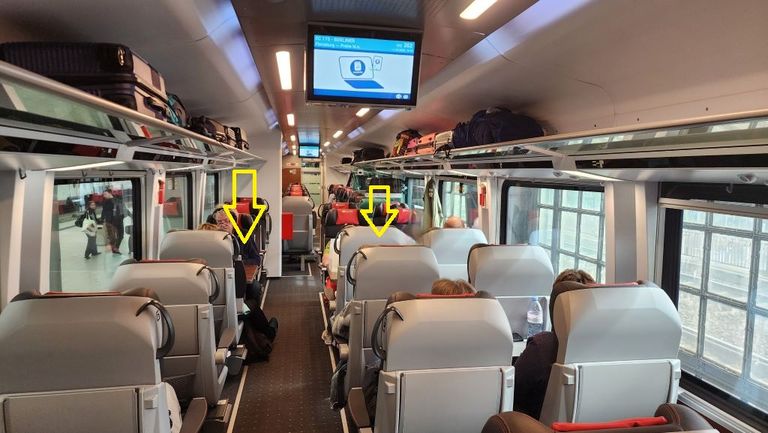
On TGV InOui trains and the TGV trains used for Lyria services between Paris and Switzerland there are some table seats which are designated as 'Family Squares'.
Lower Decks
Kids can love the idea of travelling on the upper decks of trains which have them, it's fun to climb the stairs - plus the children can suss that they will see more out of the windows.
However, when travelling with luggage and / or small kids, having to heave things up and down staircases is obviously a scenario best avoided.
So the lower decks can be a compromise worth making; particularly as the lower decks typically feel more spacious.
Though this isn't a scenario that always need to be factored in to your travel plans.
Longer -distance express trains aren't double-decked in Britain, Denmark, Italy, Norway, Spain (the Renfe services), Sweden or any country in eastern Europe including Czechia and Hungary.
Those which are include;
- Most of the TGV trains in France used on national routes; including all Ouigo services.
- The Ouigo services in Spain
- The Westbahn trains in Austria, and the IC trains operated by OBB on the Vienna to Salzburg route.
- Some of the trains used for IC services in Belgium.
- The Lyria trains between Paris and Switzerland.
- Plus most of the IC services in Germany, Switzerland and The Netherlands.
Note that German ICE trains are not-double-decked.
First Class
The core terms and age ranges, for both the discounts and free travel for kids, also typically apply when booking First Class tickets.
So once you factor in what you will be saving, travelling with kids in First Class can be a good deal.
Plus booking 1st class tickets, or using a combination of 1st class passes + 1st class reservations, can make the journeys easier to manage for multiple reasons:
- There are typically more table seats in 1st class coaches compared to 2nd class.
- If you will be taking kids + luggage on to the trains, 1st class coaches typically have more luggage / storage space.
- On trains on which reservations are not available you'll typically be more likely to find seats when boarding, because 1st class will usually be quieter.
- On many types of train including ICE trains and Railjet trains, you can order food, drinks and snacks and the catering attendant will bring them to you - thereby avoiding the need to take the kids with you to the bar / bistro counter.
Child zones
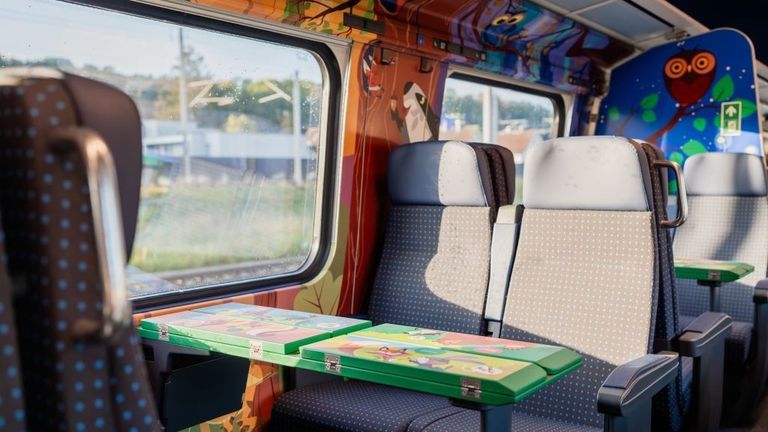
From a UK perspective if a writer is set a task of publishing an article titled 'Why Train Travel In Other European Countries Is Better', ahem, they will almost certainly include Child Friendly Zones, because trains in Britain don't have them.
However, something to keep in mind when planning journeys with kids on mainland Europe, is that Britain isn't the exception with regard to this.
Dedicated child zones are actually comparatively rare, the trains which have them include:
- Swiss IC trains (an example is pictured above) - at Swiss stations look out for the teddy bear symbol on the platform departure screens.
- Railjet trains
- Comfort Jet trains, Interjet tains and other trains in Czechia
- Vy trains in Norway
- Some longer-distance Regional trains in Austria and Switzerland
- Some Regional and InterCity trains in Sweden, but the faster Snabbtag trains don't have them.
- Intercity trains in Italy
- Most of the Euro City (EC) trains between Switzerland and Italy
Family compartments
A few European train services have compartments of seats with internal doors, which separate them from the rest of the train.
Though typically they don't suit travel with younger children as there's a possibility of having to share a confined space with other travellers.
However, this can be flipped when family compartments can be reserved for exclusive use by the travel party.
They then become spaces to play games, nurse younger children, give the kids a meal etc.
The trains on which these types of compartments can be reserved, include:
- Long-distance trains in Denmark
- Mother and baby compartments are available on some Polish express trains.
- Some express trains in Czechia
- Railjet trains
- ICE trains
Reservations
Adults will obviously need to be sat together with younger children so making reservations on trains when it's an option, is the way to go.
European train services, on which you will need to proactively add a reservation when booking tickets, include:
- ECE trains; Zurich ↔ Munich
- Comfort Jet trains
- Railjet trains
- ICE trains (within Germany and to/from Switzerland)
- Trains between Hamburg and Denmark
- EC trains to and from Germany (except during June to August when they are mandatory)
- IC trains in Switzerland and Germany and Austria and Denmark and Sweden
- Lyn services in Denmark
- on express trains in Britain and Norway
When reservations are optional on day trains they are priced at a flat rate per seat - everywhere except for Britain, where there is no charge.
So the reservations for the kids cost the same as the adult price, including when you don't need to pay for the children's tickets.
These flat rate reservation fees also apply when travelling with Eurail or Interrail passes.
With a difference to travelling with tickets being, that these rail pass reservation fees, are an additional cost when travelling on the train services / routes which have mandatory reservations.
Day trains with mandatory reservations
When booking tickets for trains with mandatory reservations there are no additional costs, plus you and the children will automatically have assigned seats -Though kids which are too young to need a ticket(s) will have to share a seat(s) with an Adult or another child.
Countries with mandatory seat reservations on national express trains: Bulgaria, Finland, France, Greece (but no charge) Hungary, Italy, Poland, Portugal, Romania, Serbia, Spain, Sweden and Turkey (no charge)
International express train routes with mandatory reservations:
Year round:
- Italy ↔ Austria, France and Switzerland
- France ↔ Belgium, Germany, Luxembourg, Italy, Spain and Switzerland
- Great Britain ↔ Belgium and France
- Poland ↔ Czechia and Germany
- Bulgaria ↔ Romania
- Hungary ↔ Croatia and Slovenia
- Estonia ↔ Latvia
June to August:
- Germany ↔ Austria, Belgium, Czechia, Denmark and The Netherlands
Popular Routes on which reservations are mandatory
Paris ↔ Amsterdam, Barcelona, Basel, Berlin, Bordeaux, Cologne, Frankfurt, Geneva, London, Marseille, Milan, Nice, Nimes, Strasbourg, Toulouse, Turin and Zurich
Milan ↔ Bari, Basel, Bern, Florence, Geneve, Lecce, Naples, Pisa, Rome, Venice and Zurich
Rome ↔ Bari, Bologna, Bern, Florence, Genoa, Lecce, Turin, Taormina, Verona and Venice
Barcelona ↔ Alicante, Lyon, Madrid, Marseille, Nimes, Paris, Seville and Valencia
Madrid ↔ Alicante, Barcelona, Bilbao, Marseille, Nimes, San Sebastian, Seville and Valencia
Stockholm ↔ Oslo
Using Seating Plans
The ticket booking and reservation services often won't automatically seat you together, despite adults and children being included on the same booking.
The seat numbers in the carriages on European trains can be arranged randomly, but the booking services will typically assign consecutively numbered seats regardless.
Hence in order to ensure that you will be sat together, using a seating plan whenever you are given the opportunity to do so, is pretty much an essential step to take.
Plus on seating plans you can proactively choose;
- table seats
- family tables; on trains which have them
- family compartments; on trains which have them
- seats on lower decks, on the double-deck trains
- seats in Child Zones; on on trains which have them
This matters, because you typically won't be automatically placed in these areas if they're available, despite including children in your booking.
You can also use the seating plans to check the availability of family compartments and table seats etc, before you commit to making a purchase
So if need be you can then look up a different departure(s) until you find one on which you can select the seats, which will make a transformative difference to your journey.
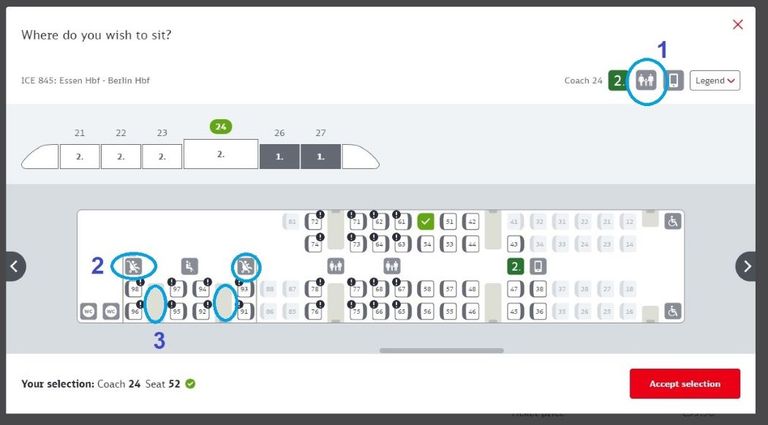
When reservations are mandatory the ticket booking paths* usually feature seating plans; Either as a step along the booking path, or with a link offering access to a plan - this second approach is taken by Trenitalia.
Booking tickets for 2nd class travel by TGV InOui trains in France and the high-speed trains in Spain, are the most notable exceptions to this.
Access to sating plans are included with the the booking confirmation when taking a Eurostar.
Seating plans are also available* for some train services on which reservations are usually optional, including:
- ICE trains
- the Railjet trains
- the Azuma trains and the Pendolino trains in the UK,
- plus most Czech express trains
*= You are more likely to have access to a seating plan if you book on the website of the train operator - which is usually the national rail company / organization.
Swiss journeys
Seating plans don't matter so much on Swiss journeys, if you will be taking an IC train simply board into the coach in which the Child Zone is located.
When you're on the platform / gleis that the train will be leaving from, look for the teddy bear symbol on the departure indicators, as it will show you in which coach the Child Zone is located.
If need be you can then move along the platform, so that you will then be in the right zone for easy boarding.
Night / Sleeper Trains
Places always have to be reserved for the Adults and Children over 4* or 5 on night / sleeper trains.
*On the Nightjet website, you can also make a reservation for Children under 4 if you won't want them to share your bed.
Though a difference to day trains is that the reservation cost for kids on night / sleeper trains is usually discounted to 50% of the Adult rate.
There will be a choice of three accommodation options:
(1) Seats; which are best avoided for obvious reasons .
(2) Couchettes: Compartments behind a door which house 4 to 6 beds* with pillows and sheets, because travellers remain in their daytime clothes
No toilets, sinks/basins or showers within the compartment.
The new type of Nightjet trains have Mini-Cabins for solo occupancy.
*Not all trains have 6 bed compartments, including the new Nightjet trains.
(3) Sleeping cabins / Compartments:
Compartments behind a door which house 2 to 3 beds with full bedding of blankets / duvets etc.
Sinks/basins included in all compartments, some also have toilets; Deluxe/Comfort cabins also have showers.
However, even if your party of Adults + Kids comprises:
- Six people and you book a 6 berth couchette
- Four people and you book a 4 berth couchette
- Three people and you book a 3 bed / place sleeping cabin
- Two people and you book a 2 bed / place sleeping cabin
your reservation can be split across multiple compartments / cabins, meaning that you may not be travelling together.
The reasons are explained on this guide to how the ticketing and reservation works on European night trains.
However, this scenario can be avoided if you are given a specific opportunity to book a 'private compartment' - because then it will live up to its name and you won't be sharing the accommodation with anybody else.
On some trains / routes it will mean forsaking the additional facilities of a sleeping cabin as couchette compartments may be the only 'private' option - Regardless, it can be the way to go for peace of mind!
Or if your journey will be by the newer type of Nightjet train, you will be given the opportunity to book multiple Mini-Cabins.
Though the kids will need to be old enough to manage the locks, lighting and other controls and use the bathroom by themselves.
Also there isn't enough space in a Mini-Cabin for an Adult to share it with a small child or an infant.
Book ahead
The seats and other spaces on trains which suit a family group are an exception to the norm.
If your journey will be easier and more enjoyable if:
- you're sat around a table
- you can occupy family compartments on day trains
- you will be in a private compartment on a night train
- you want travel any other specific type of seat(s)which can be found on a seating plan
then you'll need to plan and book ahead, because your preferences will be more likely to sell out, weeks ahead of your travel date.
Tickets and reservations usually become available;
- 1 month ahead = Poland
- Up to 2 months ahead = Denmark and Czechia and Hungary
- Up tp 12 - 13 weeks ahead = Norway
- Up to 3 months ahead = Great Britain
- 2 - 6 months ahead = Spain; it is the AVE trains to/from Madrid and the TGV trains between France and Spain that are now available up to 6 months ahead.
- Up to 4 to 6 months ahead = France; depends on the route, tickets now tend to be released sooner on the trains from and to Gare de Lyon
- Up to 4 months ahead = the IC day and night trains in Italy
- Up to 6 months ahead = Austria, the Frecce trains in Italy, Switzerland and Eurostar - on all routes, including to and from the UK
- Up to 6 months ahead = Germany to/from Austria, Czechia, Denmark, France and Poland
- Up to 12 months ahead = Germany; national journeys
- Up to 12 months ahead = Germany to/from Belgium, Switzerland and The Netherlands
- Up to 12 months ahead = Sweden.
When seats can't be booked ahead
Seat reservations aren't always available on European trains and the exceptions include virtually every Regional type of train service or route - despite the long-distances that they can travel.
They are also not on option on the express IC trains in Belgium and The Netherlands, or on the Euro City and ECD trains which travel between the two countries.
So if you'll be travelling on such a train and boarding at the station where it commences its journey, be there at least 20 mins before departure.
Then you and the kids can be among the first people to board and therefore take your pick of the seats.
Or if there's a train leaving in less than 10 mins, but there's another departing 30 mins after it, on which your tickets will be valid - stop and check the mood of the travel party,
Because hanging back, so that you can be the first to board that later train, can be the way to go.
Connections
On some journeys making a connection between trains can't be avoided.
Routes with no direct trains include;
- Amsterdam ↔ Hamburg
- Plymouth ↔ Manchester
- Lyon ↔ Bordeaux
- Cardiff ↔ Leeds
- Bristol ↔ The Lake District
- Switzerland to/from Roma and Napoli
- Paris to/from Hamburg, Madrid, Roma and Venezia/Venice
- Basel ↔ Geneve
- Marseille - Nice ↔ Genova - Milano
- Madrid ↔ Lisbon
- Salzburg - Villach ↔ Ljubljana - Zagreb (resumes Dec 14th 2026)
- Warszawa ↔ Vilnius
- Bordeaux ↔ San Sebastian
When taking an indirect route, the ticket agents and other journey planners can steer you towards making the journey in the shortest possible time, with connecting times between trains of 10 to 15 mins or less.
Those connections are ideal for solo travellers who can easily go up and stairs or speed up if they're against the clock.
But when you're with kids who may not be in the mood to hurry, or require the taking of multiple elevators in order to get from one train to another, making a 10 to 15 min transfer can be a stress-factor.
So instead take the focus off time and move it to ease.
When planning a trip, check the opportunities, by asking Sam, to take an hour or more between trains.
Use the time to have something to eat in an environment that isn't moving, get everyone in and out of the station bathrooms and other facilities, or shop for something to keep the kids happy on the next stage of the trip etc.
About the Author
Simon Harper has been writing about international rail journeys for over 10 years.